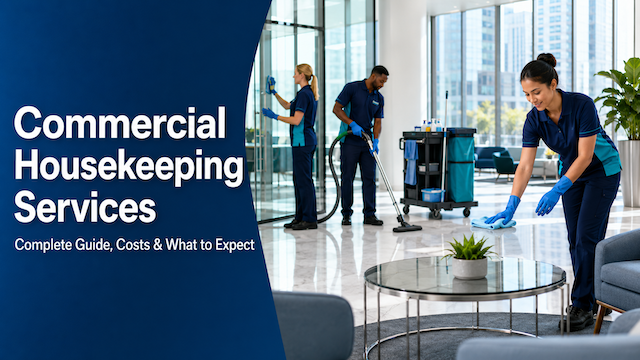
A clean workplace does more than improve appearances. It creates a better experience for employees, reassures customers and prevents everyday cleaning problems from becoming expensive maintenance issues.
Commercial housekeeping services give businesses scheduled professional cleaning without the cost and responsibility of managing an in-house cleaning team. The key is choosing a provider whose price, schedule and scope genuinely fit your premises.
Commercial Housekeeping Services: Quick Answer
Commercial housekeeping is the professional cleaning and upkeep of workplaces and other business premises. Services can include floor care, restroom cleaning, waste removal, dusting, kitchen cleaning and restocking essential supplies.
Businesses can arrange daily, weekly, after-hours or one-time cleaning. In the United States, standard commercial cleaning commonly costs around $0.10 to $0.20 per square foot, although location and service requirements can move the price higher or lower.
| Service information | Details |
|---|---|
| Suitable for | Offices, shops, hotels, schools, clinics and commercial buildings |
| Service frequency | Daily, weekly, monthly or one-time |
| Pricing method | Hourly, per square foot or fixed contract |
| Typical US rate | Approximately $0.10–$0.20 per square foot |
| Contract options | Short-term, ongoing or one-time |
| Best first step | Request an on-site assessment and written quote |
What Are Commercial Housekeeping Services?
Commercial housekeeping services involve cleaning, organizing and maintaining areas used for business.
Unlike domestic cleaning, commercial housekeeping must account for larger spaces, heavier foot traffic, workplace schedules and industry-specific requirements.
A provider may clean:
- Corporate offices
- Hotels and serviced apartments
- Retail stores
- Restaurants and cafés
- Schools and training centres
- Clinics and medical offices
- Warehouses
- Gyms and leisure facilities
- Shared residential buildings
- Event and conference venues
Some companies use “commercial cleaning,” “janitorial services” and “commercial housekeeping” interchangeably. However, housekeeping may also include room preparation, supply restocking and maintaining presentation standards throughout the day.
What Does Commercial Housekeeping Include?
A standard service normally covers frequently used areas and visible surfaces.
Office and reception areas
Tasks may include:
- Dusting desks and accessible surfaces
- Vacuuming carpets
- Mopping hard floors
- Emptying waste bins
- Cleaning doors and handles
- Wiping reception furniture
- Tidying meeting rooms
- Removing visible marks from glass
Cleaners generally do not move confidential documents or valuable personal items unless this is included in the agreement.
Restrooms
Restroom service usually includes:
- Cleaning toilets and urinals
- Washing sinks and taps
- Cleaning mirrors
- Mopping floors
- Emptying sanitary bins
- Disinfecting high-touch surfaces
- Restocking soap and paper products
Confirm whether the cleaning company supplies consumables or expects your business to purchase them separately.
Kitchens and break rooms
Typical work includes:
- Wiping counters and tables
- Cleaning sinks
- Mopping floors
- Emptying bins
- Cleaning appliance exteriors
- Removing obvious food residue
- Restocking approved supplies
Cleaning inside refrigerators, ovens or cupboards may cost extra.
Floors and carpets
Routine floor care may cover vacuuming, sweeping and mopping. Specialist services such as carpet extraction, stripping, waxing and machine polishing are normally priced separately.
Standard Cleaning vs Deep Cleaning
Routine commercial cleaning maintains a space that is already in reasonable condition. Deep cleaning tackles built-up dirt and areas not covered during regular visits.
A deep clean may include:
- Detailed skirting-board cleaning
- High-level dust removal
- Carpet extraction
- Tile and grout cleaning
- Internal window cleaning
- Floor stripping and refinishing
- Detailed kitchen cleaning
- Cleaning behind movable furniture
- Removal of built-up marks and residue
Businesses often book a deep clean before starting a recurring contract. This gives the cleaner a manageable condition to maintain.
How Much Do Commercial Housekeeping Services Cost?
Prices depend heavily on location, building type and service scope. For the US market, 2026 estimates commonly place commercial cleaning at $0.10–$0.20 per square foot per visit, with a total visit potentially ranging from about $70 to $1,500 or more.
Studies show that different businesses provides the following broad industry ranges:
| Facility type | Indicative cost per square foot |
|---|---|
| General office | $0.09–$0.17 |
| Retail premises | $0.07–$0.15 |
| School or educational building | $0.07–$0.14 |
| Industrial or manufacturing facility | $0.08–$0.20 |
| Medical or healthcare facility | $0.14–$0.29 |
These figures are budgeting estimates, not fixed quotations. Local wages, taxes and operating costs affect the final price.
Common Pricing Methods
Hourly pricing
The provider charges for each cleaner’s working time. This works well for small premises, changing workloads and one-time projects.
Hourly pricing should state whether the quoted amount applies per cleaner or to the entire team.
Price per square foot
This is common for larger buildings and recurring contracts. The provider measures the cleanable area and calculates a rate based on the work required.
A low rate can be misleading if important rooms or tasks are excluded.
Fixed price per visit
You pay an agreed amount each time the team cleans. This offers predictable costs when the scope remains consistent.
Monthly contract
A fixed monthly fee covers a defined number of visits and services. It can reduce administrative work and may provide better value than repeatedly booking one-time cleaning.
What Affects the Final Price?
Two buildings of the same size can receive very different quotes. Important pricing factors include:
- Total cleanable floor area
- Number of restrooms and kitchens
- Building layout
- Number of employees or visitors
- Cleaning frequency
- Current condition of the premises
- Floor and surface materials
- Daytime or after-hours access
- Parking and travel arrangements
- Security checks or access restrictions
- Waste volume
- Specialist equipment
- Consumable supplies
- Industry compliance requirements
A medical office, restaurant or childcare facility will usually cost more than a low-traffic administrative office of the same size.
How Often Should a Business Be Cleaned?
The right frequency depends on foot traffic and how the building is used.
| Business environment | Possible cleaning schedule |
|---|---|
| Small, low-traffic office | Once or twice weekly |
| Busy corporate office | Three to five times weekly |
| Retail store | Daily or several times weekly |
| Restaurant | Daily, with continuous hygiene tasks |
| Medical facility | Daily or multiple times per day |
| School or nursery | Daily |
| Hotel | Daily, with ongoing housekeeping |
| Warehouse | Weekly routine cleaning plus scheduled deep cleaning |
Restrooms, entrances and shared kitchens may need attention more frequently than private offices or storage rooms.
What to Expect During a Site Assessment
A professional provider should inspect your premises before offering a long-term price.
During the walkthrough, expect questions about:
- Opening hours
- Preferred cleaning times
- Building size
- High-traffic areas
- Access and alarm procedures
- Security restrictions
- Current cleaning problems
- Flooring materials
- Waste handling
- Restroom supplies
- Specialist cleaning needs
Who Manages Commercial Housekeeping Teams?
Delivering consistent commercial housekeeping requires more than cleaning equipment and a task checklist. A housekeeping supervisor normally coordinates cleaners, inspects completed work, manages supplies and ensures that service standards are followed. Businesses building an internal cleaning team can review our complete guide to the housekeeping supervisor job description to understand the responsibilities, skills and hotel or facility-management experience required for this position.
What Should Be Included in the Quote?
A useful quotation should clearly show:
- Areas to be cleaned
- Tasks included in each area
- Service frequency
- Cleaning schedule
- Number of cleaners or expected service hours
- Cleaning products and equipment provided
- Consumables included or excluded
- Price before and after tax
- Extra-service charges
- Contract duration
- Cancellation terms
- Complaint-resolution process
Avoid accepting a quote that only says “complete office cleaning.” That wording leaves too much room for disagreement.
How to Choose a Commercial Housekeeping Company
Compare the scope, not just the price
One provider may appear cheaper because it excludes windows, supplies, carpet care or weekend visits.
Ask competing companies to quote against the same written task list.
Confirm insurance
Request evidence of business liability insurance and any employee coverage required in your location.
Insurance helps protect your business if property is damaged or someone is injured while providing the service.
Ask about staff screening and training
Cleaners may work around keys, equipment and confidential areas. Ask how employees are recruited, trained, supervised and identified on arrival.
Review quality-control procedures
A reliable provider should have a system for:
- Conducting inspections
- Recording completed tasks
- Reporting problems
- Replacing absent cleaners
- Responding to complaints
- Correcting missed work
Check the cancellation clause
Understand the required notice and any early-termination fees before signing. A short trial period can help both parties evaluate the arrangement.
Questions Often Asked Before Hiring
Ask each provider:
- Have you cleaned businesses similar to ours?
- Is the company insured?
- Are cleaners employees or subcontractors?
- Who supplies products and equipment?
- Are paper products and soap included?
- How are keys and alarm codes protected?
- Who supervises the cleaning team?
- What happens when a cleaner is absent?
- Are specialist services charged separately?
- How quickly are complaints addressed?
- Can the service schedule be changed?
- What are the cancellation terms?
Clear answers are often more valuable than a polished sales presentation.
Warning Signs to Avoid
Be careful if a provider:
- Gives a long-term quote without asking about the premises
- Refuses to provide insurance information
- Offers no written scope of work
- Cannot explain who will enter your building
- Demands a large advance payment without justification
- Promises specialist cleaning without trained staff
- Has unclear extra charges
- Provides no process for reporting missed work
- Pressures you into a lengthy contract immediately
A remarkably low quote may lead to short visits, missed tasks or repeated price increases.
Commercial Housekeeping Contract Checklist
Before signing, confirm that the agreement includes:
- Exact property address and cleaning areas
- Detailed task and frequency schedule
- Start date and service times
- Monthly or per-visit price
- Tax and payment terms
- Supply and equipment responsibilities
- Key and security arrangements
- Insurance obligations
- Performance-review process
- Procedure for requesting extra work
- Damage-reporting terms
- Contract renewal and cancellation rules
Keep the proposal, task schedule and signed contract together. They provide the clearest reference if service expectations are later disputed.
Is Commercial Housekeeping Worth the Cost?
Outsourcing is often worthwhile when a business needs consistent results but does not want to recruit, train and supervise an internal cleaning team.
A suitable provider can offer:
- Predictable cleaning schedules
- Professional equipment
- Cover for staff absence
- Easier cost planning
- Trained supervision
- Flexible service levels
- Better presentation for customers and employees
Value should be measured by reliability and results—not simply by the lowest hourly rate.
How to Get an Accurate Quote
Prepare the following information before contacting a company:
- Approximate square footage
- Property type
- Number of floors
- Number of restrooms and kitchens
- Employee and visitor numbers
- Desired frequency
- Preferred service times
- Required specialist work
- Current condition
- Photographs or floor plans, if available
Request an on-site survey and obtain two or three written proposals. Ask each company to price the same scope so you can make a fair comparison.
Final Buyer Guidance
The best commercial housekeeping service is not necessarily the cheapest. It is the one that provides a clear scope, dependable staff, appropriate insurance and a practical way to correct problems.
Begin with a walkthrough, agree on measurable tasks and check all exclusions before signing. A detailed contract protects your budget and gives the cleaning team a fair standard to deliver.
Frequently Asked Questions
What is the difference between housekeeping and commercial cleaning?
Commercial cleaning focuses on cleaning business premises. Housekeeping may also include presentation, room preparation, restocking and ongoing upkeep during operating hours.
Are cleaning supplies included?
Sometimes. The contract should state whether chemicals, equipment, bin liners, soap and paper products are included.
Can cleaners work after business hours?
Yes. Many providers offer early-morning, evening or overnight service, subject to building access and security arrangements.
Do I need a long-term contract?
Not always. Providers may offer one-time cleaning, rolling monthly arrangements, trial periods or longer contracts.
How quickly can service begin?
Routine cleaning may start shortly after the assessment and agreement. Larger or specialist sites may require additional planning, equipment and staff training.
Should I choose hourly or fixed pricing?
Hourly pricing suits variable or one-time work. A fixed per-visit or monthly price is often easier to manage for recurring services.