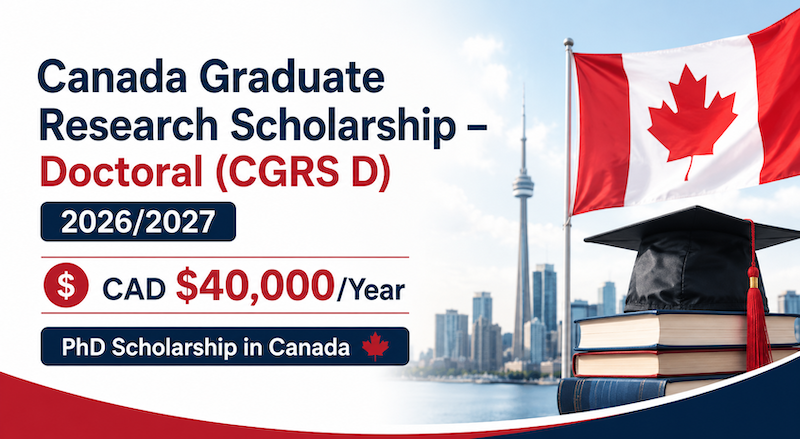
If you are looking for a high-value doctoral scholarship in Canada, the Canada Graduate Research Scholarship – Doctoral (CGRS D) is one of the most important opportunities to know about for the 2027 academic cycle.
The CGRS D is a Canadian federal research scholarship designed to support outstanding doctoral researchers in a broad range of disciplines. The award is worth CAD $40,000 per year for 36 months, providing up to CAD $120,000 over three years. The program is administered through Canada’s three federal research agencies: the Canadian Institutes of Health Research (CIHR), the Natural Sciences and Engineering Research Council of Canada (NSERC), and the Social Sciences and Humanities Research Council (SSHRC).
For international scholarship seekers, however, there is an important eligibility condition: an applicant who is not a Canadian citizen, permanent resident or protected person must already be registered in a doctoral program at an eligible Canadian institution by the application deadline. Up to 15% of the awards are available to international applicants.
Key Takeaways:
The Canada Graduate Research Scholarship – Doctoral (CGRS D) is a major Canadian doctoral research funding opportunity offering CAD $40,000 per year for 36 months.
Its strongest attraction for international applicants is that the program does provide a defined allocation for international researchers. However, the most important limitation is equally clear: international applicants must generally already be registered in an eligible Canadian doctoral program by the application deadline.
For someone planning a PhD in Canada for the 2027 period, the best approach is therefore not to treat CGRS D as a simple scholarship application that can be submitted independently from abroad.
Instead, build the application around three connected goals:
1. Secure the right Canadian doctoral program.
2. Develop a strong, research-focused academic profile and proposal.
3. Apply through the correct CGRS D channel before the applicable deadline.
The scholarship is competitive, but for applicants with strong academic preparation, meaningful research experience and a well-defined doctoral research project, it can provide substantial support while pursuing advanced research in Canada.
Official CGRS D information: Canada Graduate Research Scholarship – Doctoral (CGRS D)
SSHRC 2027 competition information: Canada Graduate Research Scholarship—Doctoral – SSHRC
CIHR CGRS D information: CIHR Health Research Training Awards
CGRS D Scholarship
| Category | Details |
|---|---|
| Country | Canada |
| Scholarship | Canada Graduate Research Scholarship – Doctoral (CGRS D) |
| Study Level | Doctoral / PhD |
| Award | CAD $40,000 per year |
| Duration | 36 months / 3 years |
| Maximum value | CAD $120,000 |
| Fields | Health; natural sciences and engineering; social sciences and humanities |
| Study mode | Research-based doctoral study |
| International applicants | Yes, subject to specific eligibility requirements |
| 2027 competition | Open |
| Application deadline | Depends on application route and agency; direct NSERC deadline is October 17, 2026, while SSHRC lists October 19, 2026 |
| Institutional deadline | Usually earlier; applicants must check their university’s deadline |
| Application route | Canadian institution or relevant federal agency, depending on applicant status |
| Scholarship status | Active |
The program is officially listed as Open by NSERC as of July 2026.
What Is the Canada Graduate Research Scholarship – Doctoral?
The Canada Graduate Research Scholarship – Doctoral is part of Canada’s Canada Research Training Awards Suite (CRTAS).
It was created to support the next generation of highly qualified researchers and help doctoral students develop advanced research skills. The program covers a wide range of disciplines and supports interdisciplinary and multidisciplinary research.
Rather than being a scholarship tied to one particular university, the CGRS D is a federal research scholarship that works through Canada’s research funding agencies and eligible institutions.
The relevant agency depends largely on the subject matter of the proposed research:
- CIHR — health-related research
- NSERC — natural sciences and engineering
- SSHRC — social sciences and humanities
Applicants are expected to select the agency that best aligns with their research subject matter.
This makes the scholarship particularly attractive to students whose doctoral work is strongly research-oriented.
How Much Does the CGRS D Pay?
The CGRS D provides:
CAD $40,000 per year
for:
36 months
This means a successful recipient can receive up to:
CAD $120,000 over three years.
The funding is intended to allow scholars to concentrate more fully on doctoral research, develop their research skills and contribute to Canada’s research ecosystem.
However, applicants should not automatically interpret the award as a complete tuition waiver. The scholarship is a financial award rather than a blanket promise that every university charge and personal expense will be eliminated.
Before accepting an offer, students should examine their university’s tuition, fees, funding policies and any other financial support available to them.
Who Can Apply for the CGRS D?
The CGRS D is highly competitive and is designed for doctoral students demonstrating strong research potential.
One important eligibility requirement is that applicants must have completed no more than 36 months of full-time-equivalent doctoral study by December 31 of the application year.
The doctoral program itself must generally be research-oriented and lead to an appropriate research output, such as:
- Thesis
- Dissertation
- Major research project
- Scholarly publication
- Research-based performance
- Research-based recital
- Research-based exhibition
Joint programs such as MD/PhD, JD/PhD, DVM/PhD and MBA/PhD can also be eligible where there is a significant autonomous research component.
Can International Students Apply?
Yes, but there is a major condition.
International applicants who are not Canadian citizens, permanent residents or protected persons must be registered in their doctoral program at an eligible Canadian institution by the application deadline. Up to 15% of CGRS D awards are available to international applicants.
This makes the CGRS D different from many international scholarships that allow students to apply from their home country before obtaining admission.
For an international applicant, the practical sequence may therefore look like:
Find a suitable Canadian PhD → obtain doctoral registration → determine the correct CGRS D application route → submit the scholarship application.
Applicants should carefully verify their individual situation because the application route also depends on their registration status and whether their institution has a quota for the relevant agency.
Which Canadian Universities Can You Attend?
The CGRS D is not restricted to one university.
Successful scholars can hold their award at eligible Canadian institutions, subject to the program’s rules.
This gives applicants considerable flexibility when choosing a doctoral research environment.
Instead of searching only for a university that advertises the CGRS D, international applicants should look for Canadian universities with:
- Strong doctoral programs in their field
- Appropriate research supervisors
- Relevant laboratories or research centres
- Strong publication and research records
- Suitable doctoral admission requirements
- Funding opportunities for international students
- A research environment that matches their proposed project
The quality of the research fit can be just as important as the scholarship itself.
What Subjects Does the CGRS D Cover?
The scholarship supports a broad range of research.
Its major research areas include:
Health
Examples may include:
- Public health
- Biomedical research
- Health systems
- Neuroscience
- Epidemiology
- Medical research
CIHR administers CGRS D competitions for eligible health-related research.
Natural Sciences and Engineering
Examples may include:
- Engineering
- Computer science
- Artificial intelligence
- Physics
- Chemistry
- Mathematics
- Environmental science
- Materials science
NSERC administers applications aligned with its research mandate.
Social Sciences and Humanities
Examples may include:
- Economics
- Education
- Sociology
- Political science
- Psychology
- History
- Communication
- Languages
- Cultural studies
SSHRC administers applications aligned with its research mandate. Its 2027 competition provides CAD $40,000 per year for three years.
Interdisciplinary and multidisciplinary research can also be supported.
How Does the Application Process Work?
One of the most important things for applicants to understand is that there is not one universal application route for everyone.
The appropriate route depends on your registration status, institution and selected funding agency.
Step 1: Identify Your Research Area
Begin with your proposed doctoral research.
Determine whether your research is primarily aligned with:
CIHR → Health
NSERC → Natural sciences and engineering
SSHRC → Social sciences and humanities
The agencies provide guidance to help applicants select the appropriate agency.
Step 2: Find a Suitable Canadian Doctoral Program
Identify universities offering doctoral programs that match your research interests.
Look beyond university rankings.
Consider whether the institution has:
- Relevant supervisors
- Appropriate research facilities
- Research funding
- Doctoral scholarships
- A suitable department
- A strong research environment
Step 3: Secure Doctoral Admission or Registration
This is particularly important for international applicants.
An international applicant must be registered in a doctoral program at an eligible Canadian institution by the application deadline.
Therefore, someone currently living outside Canada should not assume that they can simply submit a CGRS D application before being registered in Canada.
Step 4: Determine Your Application Channel
Applicants may apply through a Canadian institution or directly to the appropriate federal agency, depending on their circumstances.
For example, an international applicant currently registered in a doctoral program at a Canadian institution with a relevant agency quota normally applies through that institution.
An international student registered at a Canadian institution without a quota for the relevant agency may apply directly to the agency.
Submitting through the wrong channel can result in rejection, so applicants should verify their status carefully.
Step 5: Prepare Your Research Proposal
Your research proposal is one of the most important parts of a competitive doctoral scholarship application.
A strong proposal should communicate:
- The research problem
- The research question
- The knowledge gap
- Why the research matters
- Your methodology
- Expected contribution
- Feasibility
- Your research environment
Avoid making the proposal unnecessarily complicated.
The reviewers need to understand what you want to investigate, why it matters and why you are capable of doing the work.
Step 6: Prepare Your Academic Records
The application can require academic documentation, including transcripts.
For example, NSERC’s CGRS D application instructions require transcripts for undergraduate and graduate studies listed in the academic background section.
Applicants should begin collecting documents well before the deadline.
Step 7: Arrange References
Strong references can help demonstrate your:
- Research ability
- Academic preparation
- Independence
- Potential as a researcher
- Ability to complete doctoral-level work
Choose referees who know your academic or research work well rather than simply choosing someone with an impressive title.
Step 8: Submit Before the Correct Deadline
This is crucial.
The institutional deadline may be considerably earlier than the federal agency deadline because universities may conduct internal reviews before forwarding applications.
For the 2027 competition, NSERC lists October 17, 2026 as its direct application deadline, while SSHRC lists October 19, 2026 for applications submitted directly to SSHRC.
Therefore, do not rely on one generic “CGRS D deadline.”
Your deadline depends on:
- Your research agency
- Your registration status
- Your university
- Whether you apply through the institution or directly
What Makes a Strong CGRS D Application?
Because this is a competitive research scholarship, simply meeting the eligibility requirements does not guarantee an award.
International applicants should focus on building a coherent academic and research profile.
1. Strong Academic Record
Your previous academic performance demonstrates your ability to succeed in advanced study.
Maintain clear academic documentation and ensure that your application accurately represents your academic history.
2. Research Experience
Research experience can make your application much stronger.
Examples include:
- Master’s thesis research
- Research assistantships
- Academic publications
- Conference presentations
- Research projects
- Laboratory work
- Field research
- Data analysis
Your experience does not necessarily need to be extensive, but it should demonstrate your development as a researcher.
3. A Clear Research Question
Avoid vague proposals.
Instead of saying:
“I want to study artificial intelligence and its impact on society.”
A stronger proposal identifies a specific research problem, population, methodology and expected contribution.
4. Strong Research Fit
Your proposed project should fit the expertise of your university and potential supervisor.
A good fit can demonstrate that you have carefully considered where and how your research will be conducted.
5. Research Potential
Think beyond what you have already accomplished.
Explain how your previous academic and research experiences have prepared you for the proposed doctoral work.
What Are the Main CGRS D Restrictions?
Applicants should carefully review the restrictions before applying.
Among the program’s rules:
- Applicants may apply to only one CRTAS program per academic year through CIHR, NSERC or SSHRC.
- Applicants may apply a maximum of three times to CGRS D.
- Applicants cannot already have received a doctoral-level scholarship from CIHR, NSERC or SSHRC, including the former Vanier Canada Graduate Scholarship.
- Applicants must meet the program’s doctoral-study limits.
- The proposed doctoral program must satisfy the research-oriented requirements.
These restrictions mean that applicants should check eligibility carefully before investing significant time in an application.
Does CGRS D Cover Tuition?
The CGRS D is best understood as a doctoral research scholarship providing financial support, rather than a universal tuition-free scholarship.
The award is valued at CAD $40,000 annually for three years.
Whether the scholarship covers all or part of your tuition and other costs depends on your university’s policies and the overall funding package available to you.
International applicants should therefore calculate the expected:
- Tuition
- Student fees
- Accommodation
- Food
- Transportation
- Health-related costs
- Research expenses
- Books and equipment
- Personal expenses
before accepting a doctoral offer.
Does CGRS D Include a Post-Study Work Visa?
No.
The CGRS D is a scholarship, not an immigration program.
Receiving the scholarship does not automatically grant a Canadian work permit or permanent residence.
International students should separately check Canada’s current immigration rules concerning study permits and post-graduation work eligibility.
This is particularly important because immigration policies can change independently of scholarship policies.
Can CGRS D Lead to Permanent Residence?
There is no automatic permanent-residence pathway attached to the scholarship.
However, studying and completing a doctoral program in Canada can potentially form part of an individual’s longer-term immigration plans depending on the immigration programs and rules in effect at the time.
Applicants should treat:
Scholarship → Education → Immigration
as three related but separate matters.
A scholarship should not be advertised as a guaranteed route to Canadian permanent residence.
CGRS D vs the Former Vanier Scholarship
International scholarship seekers may encounter both programs when researching Canadian PhD funding.
The distinction is important.
| Feature | Former Vanier CGS | CGRS D |
| Status | Discontinued | Active |
| Level | Doctoral | Doctoral |
| Annual award | CAD $50,000 | CAD $40,000 |
| Duration | 3 years | 3 years |
| Maximum value | CAD $150,000 | CAD $120,000 |
| Research areas | Health, natural sciences/engineering, social sciences/humanities | Broad health, natural sciences/engineering, social sciences/humanities |
| International applicants | Yes | Yes, subject to current eligibility rules |
| Application | Institutional nomination | Institution or federal agency depending on circumstances |
The CGRS D is part of Canada’s newer harmonized research-training system, which replaced the former Vanier framework.
Application Deadline for 2027
There is not one universal CGRS D deadline.
For the 2027 competition:
Applications submitted through a Canadian institution
The deadline is determined by the institution and can be significantly earlier than the federal agency deadline.
Applicants should contact their faculty of graduate studies or equivalent office.
Direct applications
For NSERC, the direct deadline is October 17, 2026, before 8:00 p.m. Eastern Time.
For SSHRC, the 2027 competition lists October 19, 2026, before 8:00 p.m. Eastern Time for direct applications.
CIHR has its own application instructions and processes for eligible health-related research.
Because today’s date is August 14, 2026, prospective applicants should begin checking their university’s internal deadline now, rather than waiting for the October federal deadlines.
What International Applicants Should Do First
If you are currently outside Canada and interested in the CGRS D, the most important point is to understand the registration requirement.
An international applicant generally needs to be registered in a doctoral program at an eligible Canadian institution by the application deadline.
A practical preparation strategy is:
- Identify your research field.
- Identify the appropriate federal research agency.
- Research Canadian doctoral programs.
- Identify potential supervisors.
- Check doctoral admission requirements.
- Apply for doctoral admission.
- Determine whether your institution has a relevant scholarship quota.
- Confirm your CGRS D application route.
- Prepare your research proposal and supporting documents.
- Submit before your applicable institutional or agency deadline.
Starting early is particularly important because admission, supervisor discussions, transcripts, references and scholarship applications can all take time.
Documents You May Need
Requirements vary according to the agency and application route, but applicants should be prepared for documents such as:
- Academic transcripts
- Academic history
- Research proposal
- Curriculum vitae
- Research contributions
- Letters of reference or appraisal
- Proof of doctoral registration where required
- Information about the proposed doctoral program
- Research supervisor information
- Supporting documentation requested by the relevant agency
For NSERC applications, the CGRS D instructions specifically require transcripts covering undergraduate and graduate studies included in the academic background.
Always follow the latest instructions from the agency handling your application.
Why the CGRS D Is Attractive to International Researchers
The scholarship has several major advantages.
High Annual Funding
CAD $40,000 per year is substantial doctoral funding and can provide meaningful financial support during a three-year research program.
Three Years of Support
The award is provided for 36 months, allowing recipients to plan their doctoral research over a substantial period.
Broad Research Coverage
The scholarship is not limited to one academic discipline. It supports research across health, natural sciences and engineering, and social sciences and humanities.
International Applicant Allocation
International applicants are explicitly included in the program, with up to 15% of awards available to international applicants.
Strong Research Environment
Recipients become part of Canada’s broader research ecosystem, giving doctoral researchers the opportunity to develop their research careers in a country with a substantial higher-education and research sector.
Application Deadline
The application deadline for Canada Graduate Research Scholarship – Doctoral (CGRS D) 2027 | CAD ,000/Year | PhD Scholarship in Canada is October 17, 2026.
Applicants should submit all required materials before this date and verify any last-minute changes through the official scholarship source.
Frequently Asked Questions
Is the CGRS D open for 2027?
Yes. The CGRS D is currently listed as an open funding opportunity for the 2027 competition.
How much is the CGRS D scholarship?
The award is CAD $40,000 per year for three years, for a potential total of CAD $120,000.
Can international students apply?
Yes, but international applicants must generally be registered in a doctoral program at an eligible Canadian institution by the application deadline. Up to 15% of awards are available to international applicants.
Can I apply from outside Canada without doctoral registration?
For international applicants, the CGRS D rules require registration in an eligible Canadian doctoral program by the application deadline. Therefore, applicants outside Canada should carefully plan their doctoral admission and registration before relying on CGRS D funding.
Does CGRS D cover tuition?
It provides a CAD $40,000 annual scholarship, but applicants should not assume that it automatically eliminates all tuition and university expenses.
What degree does the scholarship support?
The CGRS D supports eligible doctoral-level research programs, including qualifying PhD and certain joint doctoral programs.
What research fields are eligible?
The program covers broad areas of health, natural sciences and engineering, and social sciences and humanities, including interdisciplinary and multidisciplinary research.
How many times can I apply?
Applicants can apply a maximum of three times to the CGRS D program.
Can I apply for both CGRS D and another CRTAS scholarship?
Applicants can apply to only one CRTAS program per academic year through CIHR, NSERC or SSHRC.
What replaced the Vanier Canada Graduate Scholarship?
The CGRS D is part of the newer Canada Research Training Awards Suite, which consolidated Canada’s federal research-training scholarships and fellowships.