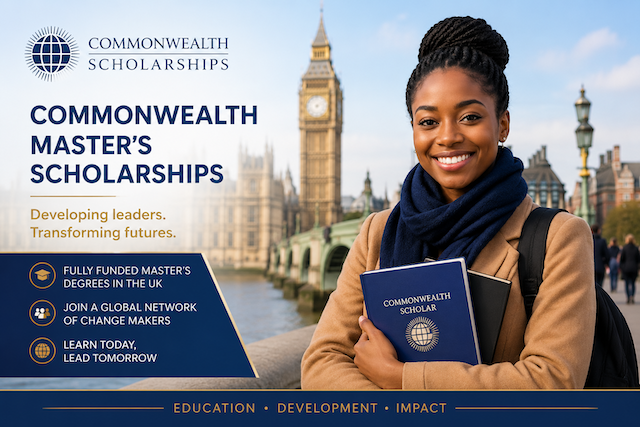
Studying for a Master’s degree in the UK can be expensive, especially when you add tuition, accommodation, flights and everyday living costs. The Commonwealth Master’s Scholarship removes much of that financial pressure for eligible students.
Funded by the UK Foreign, Commonwealth & Development Office (FCDO), the scholarship supports students from eligible low- and middle-income Commonwealth countries who would otherwise struggle to afford postgraduate study in the UK.
For the 2027/28 academic year, the application portal opened on 8 September 2026, with studies beginning in September / October 2027.
Commonwealth Master’s Scholarships 2027
| Scholarship Information | Details |
|---|---|
| Country: | United Kingdom |
| University: | UK universities |
| Scholarship name: | Commonwealth Master’s Scholarship |
| Program: | Eligible one-year taught Master’s programmes |
| Degree: | Master’s degree |
| Tuition Amount: | Full approved tuition fees |
| Currency: | GBP (£) |
| Scholarship Availability: | Students from eligible low- and middle-income Commonwealth countries |
| Language Requirements: | CSC itself does not require IELTS; applicants must meet the admission requirements of their chosen university |
| Duration: | Normally 1 year |
| Intake: | September/October 2027 |
| Study Mode: | Full-time, in the UK |
| Post Study Work Visa: | Not permitted under the scholarship conditions – Scholars commit to returning home after the award |
| Application Deadline: | 20 October 2026 at 16:00 BST; nominators may have earlier deadlines |
| Scholarship Status: | Open |
| Award Amount: | Full tuition + £1,712/month living allowance, or £2,000/month in the London metropolitan area + airfare and other eligible allowances |
| Application Link: | Official Commonwealth Master’s Scholarship Page |
| Study Level: | Postgraduate / Master’s |
The CSC funds one-year taught Master’s programmes only under this scheme and does not fund MBA programmes.
About Commonwealth Master’s Scholarships
The Commonwealth Master’s Scholarship is part of the UK government’s Commonwealth Scholarship programme.
Its purpose is not simply to bring international students to Britain. The programme is designed to identify talented people who can gain advanced knowledge in the UK and use that knowledge to contribute to development in their home countries.
The scholarship is available for full-time taught Master’s study at approved UK universities.
This makes it particularly attractive if you have good academic results and clear career ambitions but cannot realistically finance international tuition and living expenses yourself.
Eligible countries currently include Nigeria, Ghana, Kenya, India, Pakistan, South Africa, Uganda, Tanzania, Rwanda, Zambia, Sierra Leone, Jamaica, Malaysia, Sri Lanka and several other Commonwealth countries.
Aim and Benefits of Commonwealth Master’s Scholarships
The scholarship aims to help talented students acquire knowledge and skills that can contribute to sustainable development.
This development focus matters when preparing your application. You should be able to explain not only why you want a Master’s degree, but also what you intend to do with the education afterwards.
What does the Commonwealth Master’s Scholarship cover?
Successful applicants receive a comprehensive funding package that includes:
- Fully approved tuition fees,
- Tuition waiver.
- Return airfare from the Scholar’s home country to the UK
- £1,712 monthly living allowance
- £2,000 monthly allowance for Scholars studying at universities within the London metropolitan area
- Study travel grant for approved study-related travel
- Additional disability-related support where applicable
- Certain child allowances for qualifying Scholars who are widowed, divorced or single parents
The stipend figures are the current rates published by the CSC and may change.
This is why the Commonwealth Master’s award can properly be described as a fully funded scholarship.
CSC Participating UK Universities
The Commonwealth Scholarship Commission (CSC) currently lists 86 UK universities/institutions that have signed an MOU with the CSC. Commonwealth Master’s Scholars are only placed at universities with an MOU.
- Aberystwyth University
- Anglia Ruskin University
- Aston University
- Bangor University
- Bath Spa University
- Bournemouth University
- Brunel University London
- Cardiff Metropolitan University
- City St George’s, University of London
- Cranfield University
- Durham University
- Edge Hill University
- Glasgow Caledonian University
- Goldsmiths, University of London
- Harper Adams University
- Imperial College London
- Keele University
- King’s College London
- Kingston University
- Lancaster University
- Leeds Beckett University
- Liverpool Hope University
- Liverpool John Moores University
- Liverpool School of Tropical Medicine
- London School of Economics and Political Science
- London School of Hygiene and Tropical Medicine
- Loughborough University
- Manchester Metropolitan University
- Newcastle University
- Northumbria University
- Queen Margaret University
- Queen Mary, University of London
- Queen’s University Belfast
- Robert Gordon University
- Royal Holloway, University of London
- Royal Veterinary College
- Sheffield Hallam University
- SOAS, University of London
- Staffordshire University
- Swansea University
- Teesside University
- The Glasgow School of Art
- Ulster University
- University College London
- University of Aberdeen
- University of Bath
- University of Birmingham
- University of Bradford
- University of Brighton
- University of Bristol
- University of Cambridge
- University of Chester
- University of East Anglia
- University of Edinburgh
- University of Essex
- University of Exeter
- University of Glasgow
- University of Greenwich
- University of Hertfordshire
- University of Huddersfield
- University of Hull
- University of Kent
- University of Leeds
- University of Leicester
- University of Liverpool
- University of Manchester
- University of Northampton
- University of Nottingham
- University of Oxford
- University of Plymouth
- University of Portsmouth
- University of Reading
- University of Salford
- University of Sheffield
- University of Southampton
- University of St Andrews
- University of Stirling
- University of Strathclyde
- University of Sussex
- University of the West of England
- University of the West of Scotland
- University of Warwick
- University of Westminster
- University of Worcester
- University of York
- York St John University
Requirements for Commonwealth Master’s Scholarships
Before spending hours preparing an application, check the basic eligibility requirements carefully.
For the 2027/2028 scholarship, applicants generally need to:
- Be a citizen of, have refugee status granted by, an eligible Commonwealth country, or be a British Protected Person.
- Be permanently resident in an eligible Commonwealth country.
- Be available to begin studying in the UK in September 2027.
- Hold, by September 2027, at least an upper second-class (2:1) first degree.
- Alternatively, hold a lower second-class degree plus a relevant postgraduate qualification, usually a Master’s degree.
- Demonstrate that they could not afford to study in the UK without the scholarship.
- Submit all required supporting documentation correctly and on time.
There is no general age limit for CSC applications.
Documents you should prepare
Your application will need supporting evidence. This includes proof of citizenship or qualifying refugee status, complete higher-education transcripts and references.
At least two references must be uploaded with the application in the required PDF format. Missing required documents can make an otherwise strong application ineligible.
Do you need IELTS?
The CSC states that it does not require candidates to take IELTS.
However, don’t interpret this as meaning English-language requirements never apply. Your chosen UK university may have its own English-language admission conditions, which you still need to satisfy.
Interview Date, Process and Venue for Commonwealth Master’s Scholarships
There isn’t one universal interview date or venue that applies to every Commonwealth Master’s applicant.
This is because applicants must apply through an approved nominating body, normally their country’s national nominating agency or an eligible NGO/charitable organisation. Each nominator runs its own selection process and may introduce additional requirements or deadlines.
Your country’s nominating agency may therefore communicate interview or screening arrangements directly to shortlisted candidates.
After nomination, the CSC considers candidates using factors including:
Academic merit – the strength of your academic background.
Quality of your proposed study – whether your chosen Master’s programme makes sense for your objectives.
Development impact – how your education could contribute to development in your home country.
A nomination does not guarantee that you will receive the scholarship.
For the 2027/2028 cycle, nominators are expected to submit their nominations to the CSC by December 2026, while applicants can expect to receive the final outcome by July 2027.
Application Deadline
The official CSC application deadline for the 2027/28 Commonwealth Master’s Scholarships is 20 October 2026 at 16:00 BST.
Applications opened on 8 September 2026.
The scholarship is for programmes beginning in September/October 2027.
There is one deadline issue you should take seriously: your nominating agency may set an earlier deadline.
So don’t wait until October before investigating how applications work in your country.
Application Deadline
The application deadline for Commonwealth Master’s Scholarships 2027: Eligibility, Benefits and How to Apply is October 20, 2026.
Applicants should submit all required materials before this date and verify any last-minute changes through the official scholarship source.
How to Apply for Commonwealth Master’s Scholarships
There are effectively two important parts to the application process.
Step 1: Check your eligibility
Confirm that your country appears on the official eligible-country list and that you meet the academic and residency requirements.
Step 2: Choose your Master’s programmes
Research suitable one-year taught Master’s programmes at approved UK universities.
The CSC advises applicants to list three universities and courses in order of preference. Providing second and third choices is strongly recommended because placement at your first-choice institution cannot always be guaranteed.
Step 3: Apply for university admission
Don’t assume the scholarship application automatically becomes a university application.
The CSC advises candidates to take the necessary steps to apply to their preferred universities. University admission deadlines can also be different from the scholarship deadline.
Step 4: Apply through CSC Central
Applications to the Commonwealth Scholarship Commission are submitted electronically through CSC Central.
Late applications or documents submitted outside the official system are not accepted.
Step 5: Apply through an approved nominator
This step is easy to overlook.
You must also apply through an eligible nominating agency. The main application route is usually the national nominating agency in your home country, although selected NGOs and charitable organisations may also participate.
The CSC does not accept direct applications without nomination for this scholarship.
Step 6: Make your development-impact case strong
This can be one of the most important parts of your application.
The application asks candidates to explain development challenges connected with their proposed study, how they will use their new skills after completing the scholarship, the outcomes they hope to achieve, who will benefit and how their impact could be measured.
Avoid writing vague statements such as:
“I want this scholarship because studying in the UK will help me achieve my dreams.”
Instead, connect the dots:
Problem in your country → Master’s programme → skills you will gain → what you will do after graduation → people or communities that could benefit.
That gives the selection committee a much clearer reason to invest in you.
Can You Stay in the UK After the Commonwealth Scholarship?
This point deserves special attention.
Although the UK has a Graduate visa route for many international graduates, Commonwealth Scholars under this programme commit to returning to their home countries after completing their scholarships.
The CSC explicitly states that switching to a Graduate or another visa to remain in the UK is not permitted under the scholarship conditions.
So if your main objective is permanent migration to the UK immediately after graduation, this particular scholarship may not match your plans.
Final Advice
The Commonwealth Master’s Scholarship is a fantastic opportunity, but a strong academic record alone won’t carry the entire application.
Think about the bigger question:
Why should the Commonwealth invest in your education?
Your application should show a believable connection between your past experience, your chosen Master’s programme and what you intend to contribute when you return home.
Start researching universities now. Prepare your transcripts. Speak to potential referees early. Most importantly, work on your development-impact statement before applications open.
With applications scheduled to open on 8 September 2026 and close on 20 October 2026, early preparation can make the process considerably less stressful.