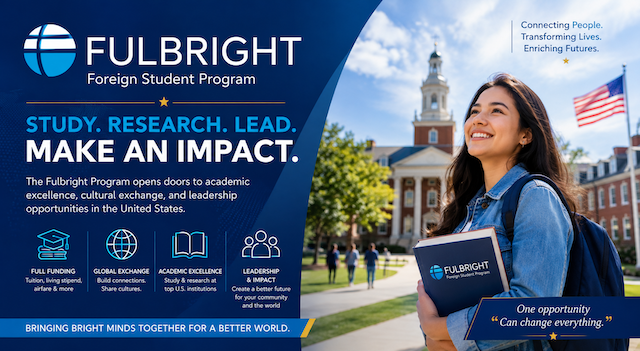
Do you want to earn a master’s or doctoral degree in the United States without paying the entire cost yourself? The Fulbright Foreign Student Program is one of the most valuable funding opportunities available to international graduate students, researchers, professionals and artists.
Approximately 4,000 international students receive Fulbright grants annually. Successful applicants may receive tuition support, a living allowance, travel funding, health benefits and J-1 visa sponsorship.
Fulbright is not attached to one university. Applicants normally apply through the Fulbright Commission, foundation or U.S. Embassy in their home country. This means the deadline, eligible fields, funding package and selection process can differ by nationality.
Quick answer: The Fulbright Foreign Student Program is generally classified as fully funded. It supports eligible international students pursuing graduate study or research in the United States, but the exact benefits and deadline must be verified for the applicant’s country.
Fulbright Foreign Student Scholarship Summary
| StudyFinder field | Verified classification |
|---|---|
| Country | United States |
| University | Participating U.S. universities and research institutions |
| Scholarship name | Fulbright Foreign Student Program |
| Program | Most eligible academic and research fields |
| Study level | Postgraduate |
| Degree | Master’s, doctorate or non-degree graduate research |
| Full tuition cost | Varies by institution; eligible tuition support depends on the country award |
| Currency | USD |
| Scholarship availability | Fully Funded |
| Funding type | Government-funded graduate scholarship and exchange grant |
| Language requirements | Recommended TOEFL PBT 550, TOEFL iBT 79–80 or IELTS 6.5; local requirements may differ |
| Eligibility | Eligible non-U.S. applicants with the equivalent of a U.S. bachelor’s degree, a good academic record and sufficient English proficiency |
| International students | Yes |
| Duration | One year or longer, depending on the degree or research award |
| Intake | Varies by country; normally the following U.S. academic year |
| Study mode | Full-time |
| Post-study work visa | Not a standard scholarship benefit; Fulbright uses J-1 exchange sponsorship and normally expects participants to return home |
| Application deadline | Varies by country |
| Scholarship status | Country-specific |
| Award amount | No universal fixed amount; determined by the country award and approved study costs |
| Application link | Official Fulbright Foreign Student application page |
What Is the Fulbright Foreign Student Program?
The Fulbright Foreign Student Program is a U.S. government-supported international educational exchange program.
It enables qualified applicants from outside the United States to pursue:
- A master’s degree
- A doctoral degree
- Graduate-level research
- Approved professional or artistic study
The program operates in more than 150 countries. Unlike a scholarship offered by one university, Fulbright can place or support students at different participating American institutions.
The application is managed outside the United States through national Fulbright offices and U.S. Embassies. Applicants should therefore begin with the competition serving their country—not with a random American university application.
Why Apply for a Fulbright Scholarship?
Fulbright is particularly attractive to students who need substantial financial assistance to study in America.
Depending on the national competition, possible benefits include:
- Tuition funding
- Monthly maintenance allowance
- International airfare
- J-1 visa sponsorship
- Health benefit plan
- Books or academic-material allowance
- Research-related support
- Settling-in allowance
- Cultural and professional enrichment activities
- Access to an international alumni network
The program also carries significant academic and professional recognition. Receiving a Fulbright award can strengthen a candidate’s research profile, international network and future career opportunities.
Is Fulbright Fully Funded?
Fulbright does not give every recipient one identical financial package.
The amount and coverage depend on:
- Applicant’s country
- Type and length of program
- University placement
- Tuition charged
- Approved living costs
- Available co-funding
- National Fulbright rules
Before accepting an award, obtain a written funding breakdown showing tuition, stipend, travel and other approved allowances.
What Fulbright May Not Cover
Even where a country describes its award as fully funded, applicants should confirm whether it pays for:
- University application fees
- Standardized tests
- Credential evaluation
- Dependent or family expenses
- Extra travel
- Personal debts
- Non-approved research costs
- Costs exceeding the grant limit
- Optional university services
- Immigration costs for accompanying relatives
Who Can Apply?
General Fulbright eligibility normally requires applicants to:
- Be citizens or eligible residents of a participating country.
- Apply through the Fulbright office serving that country.
- Reside in the nominating country when applying.
- Hold the equivalent of a U.S. bachelor’s degree before the program begins.
- Have a good academic record.
- Demonstrate sufficient English proficiency.
- Meet country-specific academic or professional conditions.
- Satisfy the admission requirements of the eventual U.S. institution.
- Present a clear study or research objective.
- Demonstrate suitability for an international exchange program.
- Be willing to comply with the J-1 visa conditions.
U.S. citizens and U.S. dual citizens are not eligible for the Foreign Student Program. They should investigate the separate Fulbright U.S. Student Program.
Eligible Courses and Fields of Study
Fulbright supports many academic areas, including:
- Agriculture
- Business and economics
- Computer science
- Education
- Engineering
- Environmental studies
- Humanities
- Law
- Public administration
- Public health
- Social sciences
- Science and technology
- Arts and related academic fields
Country offices can prioritize or exclude particular subjects.
Programs involving clinical patient care—such as clinical medicine, dentistry, pharmacy and nursing—are generally unavailable. Non-clinical fields such as public health and nursing administration may be eligible.
Always check the approved fields for your country before applying to a university.
English-Language Requirements
Fulbright’s general recommended scores for Foreign Student applicants include:
- TOEFL paper-based: 550
- TOEFL iBT: 79–80
- IELTS: 6.5 overall
These are general recommendations rather than universal admission guarantees. A university or national Fulbright office may require a higher score.
Do not pay for a test until you have reviewed your country’s instructions. Some programs arrange testing for shortlisted applicants, specify a particular examination or accept scores at a later selection stage.
Application Deadline
There is no single worldwide Fulbright Foreign Student deadline.
Use the following StudyFinder classification:
- Application deadline: Varies by country
- Scholarship status: Country-specific
- Deadline confidence: National verification required
Applicants must use the official country selector to locate the responsible Fulbright Commission or U.S. Embassy.
Deadline for Nigerian applicants
For the Fulbright Foreign Student Program administered in Nigeria, the published 2027 competition deadline was:
June 1, 2026
That competition is now closed. Nigerian applicants should monitor the U.S. Embassy in Nigeria for the next application cycle.
Documents Required for a Fulbright Application
Requirements differ by country, but applicants should prepare for documents such as:
- Completed online application
- Passport or citizenship information
- Academic transcripts
- Degree certificates
- Curriculum vitae or résumé
- Personal statement
- Study objective
- Research proposal, where applicable
- Professional or academic references
- English-language test result
- Standardized graduate-test result, where required
- Writing sample or portfolio for certain fields
- Employment history
- Research and publication record
- Proof of institutional affiliation, where applicable
Documents not issued in English may need an acceptable translation.
Do not upload false, altered or unverifiable academic records. Fulbright offices and universities may check credentials before finalising an award.
How to Apply for the Fulbright Foreign Student Program
Step 1: Find the Fulbright program for your country
Visit the official Fulbright application page and select your country.
Confirm:
- Whether applications are open
- Eligible degrees
- Approved fields
- Deadline
- Required documents
- Work-experience requirements
- Testing procedure
- University-placement method
Step 2: Check whether your country uses placement or self-placement
Fulbright application routes can include:
- IIE placement: The Fulbright office and Institute of International Education assist with university applications and placement.
- Self-placement: The applicant applies directly to approved U.S. universities.
- Mixed placement: Responsibilities are divided between the applicant and program administrators.
Do not apply to several universities before confirming which route your national competition uses.
Step 3: Confirm your academic eligibility
Check whether your qualification is equivalent to a U.S. bachelor’s degree and whether your proposed field is eligible.
Some countries also require:
- Relevant employment experience
- A minimum academic result
- Public-service experience
- Current university employment
- A research affiliation
- Commitment to return home
Step 4: Prepare the application documents
Request transcripts and certificates early. Update your CV and begin drafting your study objective before the portal approaches its closing date.
Step 5: Choose suitable referees
Select lecturers, research supervisors or employers who know your work and can provide specific evidence of your ability.
Give them:
- Your CV
- Proposed field
- Study objective
- Submission instructions
- Correct deadline
Step 6: Complete and review the application
Confirm that:
- Every required field is complete.
- Your academic dates are consistent.
- Transcripts are readable.
- Essays answer the questions.
- References have been submitted.
- Your proposed field matches the country rules.
- Contact information is accurate.
Step 7: Submit before the deadline
Do not wait until the final day. Scholarship portals can slow down when many applicants attempt to submit simultaneously.
How the Fulbright Selection Process Works
The process varies, but it may include:
- Eligibility screening
- Academic and professional assessment
- Review of essays and study objectives
- Shortlisting
- Panel interview
- English or graduate admission testing
- National nomination
- Review by Fulbright authorities
- University application or placement
- Medical and visa processing
- Final award confirmation
Passing a national interview does not always mean the grant is final. University admission, funding approval and visa requirements may still need to be completed.
How to Write a Strong Fulbright Study Objective
Your study objective should explain:
- What you want to study
- Why the field matters
- What experience prepared you
- What skills or knowledge you still need
- Why graduate study in the United States is appropriate
- How you will use the training afterward
- What contribution you intend to make at home
Avoid a statement built mainly around financial need. Fulbright already knows applicants require funding.
Your strongest commercial or professional angle is the result you intend to create—not the price of the degree.
For example, instead of writing:
I want to study environmental engineering because I care about the environment.
Explain the specific environmental problem you have encountered, your previous work, the knowledge gap you need to address and how advanced training would improve your ability to develop solutions.
Your Personal Statement Matters
The personal statement should complement your study objective rather than repeat it.
Use it to show:
- Important academic or professional experiences
- Challenges that influenced your direction
- Leadership and community involvement
- Ability to adapt
- Cross-cultural awareness
- Personal qualities relevant to the program
- Long-term commitment to your field
Keep the writing direct and credible. Selection panels usually respond better to clear evidence than exaggerated claims.
How to Choose Strong Fulbright Referees
A suitable referee should be able to discuss your:
- Academic ability
- Research experience
- Professional competence
- Leadership
- Communication skills
- Reliability
- Future potential
A detailed letter from a lecturer or supervisor who knows your work is often stronger than a generic endorsement from a high-ranking person.
Ask early and confirm that every reference reaches the application system before the deadline.
Understand the J-1 Visa Conditions
Fulbright Foreign Student participants normally receive J-1 exchange visitor sponsorship.
Some J-1 participants are subject to the two-year home-country physical-presence requirement. When applicable, the recipient must spend a total of two years in the home country before becoming eligible for certain U.S. visas or permanent residence, unless a waiver is granted.
Fulbright should therefore not be marketed as a direct U.S. immigration or permanent-employment pathway.
The program’s primary purpose is academic exchange, professional development and improved mutual understanding between countries.
Is Fulbright Worth Applying For?
Fulbright is a strong option if you:
- Have a competitive academic record.
- Need substantial financial assistance.
- Want graduate education or research experience in America.
- Have a clear academic or professional direction.
- Can explain how the training will benefit your country or community.
- Are comfortable with the exchange-program conditions.
- Can prepare strong essays and recommendations.
Competition is intense. Apply for Fulbright while also considering:
- University merit scholarships
- Need-based financial aid
- Graduate assistantships
- Teaching assistantships
- Research assistantships
- Departmental fellowships
- External foundations
- Government scholarships
Do not depend on one scholarship result for your entire study-abroad plan.
Common Fulbright Application Mistakes
Avoid:
- Using a deadline from another country
- Applying through an unofficial website
- Choosing an excluded field
- Writing vague study objectives
- Focusing only on financial need
- Submitting generic recommendation letters
- Ignoring the J-1 visa conditions
- Assuming every award pays identical benefits
- Applying directly to universities without checking the placement route
- Waiting until the closing day
- Uploading incomplete academic records
- Describing Fulbright as a guaranteed immigration pathway
Check Your Eligibility
You may be ready to apply if you can answer “yes” to these questions:
- Are you a citizen or eligible resident of a participating country?
- Do you hold the equivalent of a U.S. bachelor’s degree?
- Is your proposed program permitted by your country competition?
- Do you have a strong academic or professional record?
- Can you demonstrate English proficiency?
- Do you have a clear study or research objective?
- Can you obtain credible recommendations?
- Are you prepared to comply with J-1 exchange conditions?
If your country’s competition is closed, use the waiting period to prepare transcripts, develop your study objective and identify referees.
Final Applicant Guidance
The Fulbright Foreign Student Program can remove much of the financial pressure associated with graduate study in the United States. Its value goes beyond tuition: recipients gain international experience, academic connections and access to a respected alumni community.
Your application should not communicate only that you need money. It should show:
What you want to study → why it matters → what you have already achieved → what training you need → how you will use that training afterward.
Begin with your national Fulbright office. Confirm the deadline and placement route, prepare your documents and submit early.
Application Deadline
The application deadline for Fulbright Foreign Student Scholarship Program is October 1, 2026.
Scholarship CLOSED: the verified application deadline has passed. Applicants should check the official source for a future application cycle.
Frequently Asked Questions
Is the Fulbright Foreign Student Program fully funded?
It is generally classified as fully funded, but the precise benefits vary by country and award.
How much money does Fulbright provide?
There is no single worldwide amount. Funding depends on the country competition, university costs, program length and approved allowances.
Can Nigerian students apply?
Yes, when the Nigerian competition is open and the applicant meets its requirements.
What was the Nigerian deadline?
The published deadline for the referenced 2027 Nigerian competition was June 1, 2026. Applicants should check the U.S. Embassy in Nigeria for the next cycle.
Can undergraduate students apply?
The Foreign Student Program is intended primarily for graduate-level study and research. It is not a standard undergraduate scholarship.
Do I need admission before applying?
It depends on the country and placement model. Some applicants are placed by Fulbright, while self-placed candidates apply directly to universities.
Does Fulbright accept IELTS?
Fulbright’s general guidance recommends IELTS 6.5. Country offices and universities may apply different rules.
Does Fulbright cover airfare?
Many awards include international travel support, but applicants must verify this in their country-specific benefits.
Can I bring my family?
Immigration rules may permit eligible dependants, but financial support for family members is not automatically guaranteed.
Can I remain in the United States after Fulbright?
Fulbright is not a direct immigration program. J-1 conditions, including a possible two-year home-country requirement, may apply.
Where should I apply?
Apply through the Fulbright Commission, foundation or U.S. Embassy responsible for your home country. Start with the official country application directory.